

nphcvq.over-blog.com/
9 Janvier 2021

From //SEIBERT/MEDIA - one of Atlassian's biggest partners worldwide - comes the #1-rated Confluence diagramming solution. Dmg canvas 2 3 4. Draw.io is the leading diagramming app when it comes to active installs and reviews on the Atlassian Marketplace. Draw.io is much more than just a flowchart maker. Its powerful versatility can help you create diagrams for. Draw clues and guess the words to win! DrawThis.io is an online version of Pictionary. As the artist, you can use different colors to draw the secret clue.
This unofficial extension integrates Draw.io into VS Code.
.drawio, .dio, .drawio.svg or .drawio.png files in the Draw.io editor.*.drawio, *.drawio.svg or *.drawio.png file and open it..drawio.svg are valid .svg files that can be embedded in Github readme files! No export needed..drawio.png are valid .png files! No export needed. You should use .svg though whenever possible - they look much better!Draw.io: Convert To.. command.You can directly edit and save .drawio.svg and .drawio.png files.These files are perfectly valid svg/png-images that contain an embedded Draw.io diagram.Whenever you edit such a file, the svg/png part of that file is kept up to date.
The logo of this extension is such a .drawio.png file that has been created with the extension itself!
If diffs are important for you, you should prefer .drawio and avoid .drawio.png diagrams.
With version 1.0 of this extension, extensive support for VS Code Liveshare has been added. You can now edit or present your Draw.io diagrams remotely, while seeing each participant's cursor and selection! This can be used for discussing, reviewing or brainstorming diagrams.With Draw.io's freehand drawing tool and integrated LaTeX support, this extension becomes an advanced whiteboard solution that can be used for remote code interviews!
Internally, this extension synchronizes Draw.io diagrams with text documents.These text documents are shared by Liveshare. As Liveshare has no understanding of the text, modification conflicts might occur on simultaneous modifications.
In the status bar, you can enable or disable the code link feature.If it is enabled and you double click on a node whose label starts with #,you will perform a workspace search for a symbol matching the rest of the label.
If you have a node labeled #MyClass and a class of name MyClass, you will jump to its source if you double click the node!
Please note that you have to open at least one file of the project that contains the symbol.Otherwise, VS Code will not consider this project when searching for symbols.This file itself does not have to contain the symbol though.
Thanks to my latest github sponsors, this feature is open source and freely available now.
TIP: If you open the draw.io editor to the right side (i.e. the second editor column) and navigate to a symbol,the diagram will stay visible.
Theme 'atlas'
Theme 'Kennedy'
Theme 'min'
Theme 'dark'
.svg Files With The Draw.io EditorBy default, this extension only handles *.drawio.svg files.Add this to your VS Code settings.json file if you want to associate it with .svg files:
You won't be able to edit arbitrary SVG files though - only those that have been created with Draw.io or this extension!
You can open the same *.drawio file with the Draw.io editor and as xml file.They are synchronized, so you can switch between them as you like it.This is super pratical if you want to use find/replace to rename text or other features of VS Code to speed up your diagram creation/edit process.Use the File: Reopen With.. command to toggle between the text or the Draw.io editor. You can open multiple editors for the same file.
If you like this extension, you might like my other extensions too:
Summary : Before you make it, draw it!
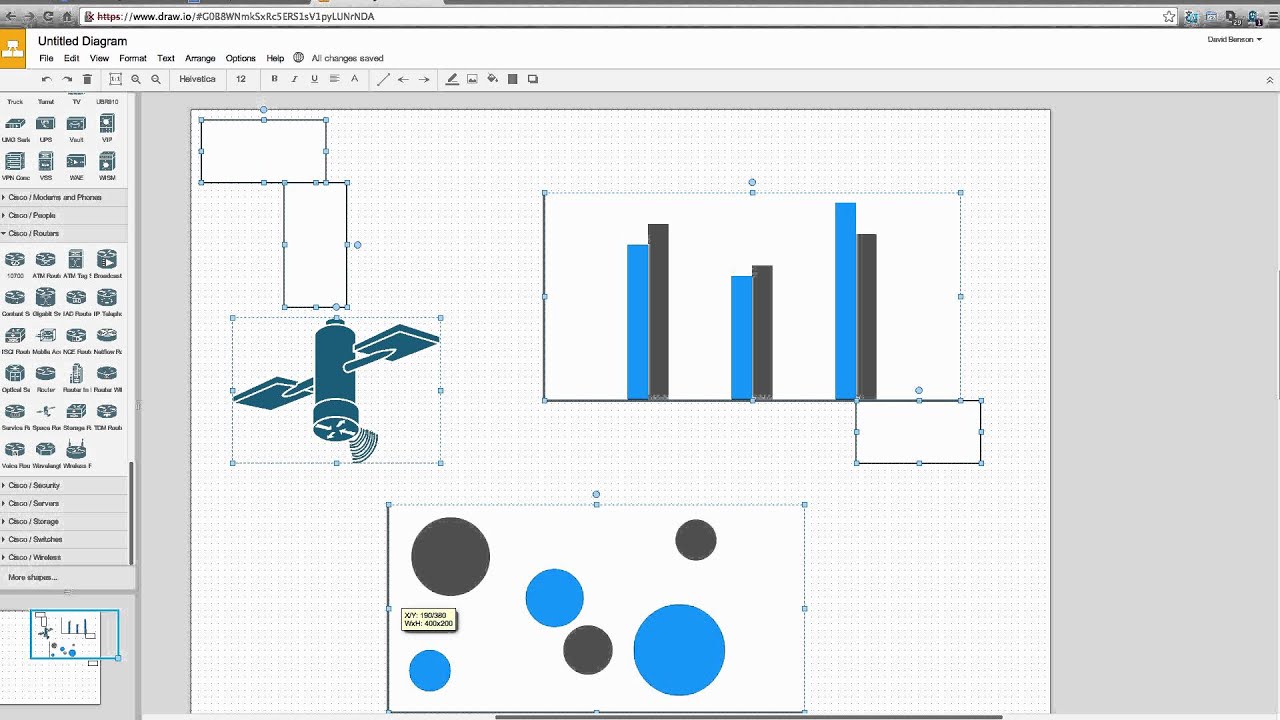
Draw.io provides users with a blank workspace they can use to design charts and take notes. To begin, users must open Draw.io and choose where they wish to save their work (e.g., Google Drive, Dropbox, OneDrive, or to their device). Next, Draw.io asks users to title their work, and it loads different templates users can select. If users do not wish to use a template, they can choose the blank option. At this point, users must click the 'Create' button, and Draw.io loads their template or blank workspace. Users can then add information to it by clicking the '+' on the top row to select the type of content they wish to add (e.g., text, shapes, links, flow charts, tree charts, and more!). Depending on the content selected, Draw.io will either load it into the work area or offer a method for uploading or linking the content. As content is selected and added, users can manipulate it by clicking the content in the workspace and choosing different options, such as colors, resizing the content, or thickening or thinning lines. Depending on the content added, users can further manipulate it using advanced settings found in the 'Edit' and 'Arrange' options. When finished, users can save their work by choosing 'save as' under the 'File' menu and picking a location.
| A1. Rigor |
| A2. 21st Century Skills |
| A3. Conn. to Future Learning |
| A4. Value of Errors |
| A5. Feedback to Teacher |
| A6. Level of Material |
| A7. Cooperative Learning |
| A8. Accom. of Individual Diff. |
| B1. Ability to Save Progress |
| B2. Platform Integration |
| B3. Screen Design |
| B4. Ease of Use |
| B5. Navigation |
| B6. Goal Orientation |
| B7. Information Presentation |
| B8. Media Integration |
| B9. Cultural Sensitivity |
| C1. Learner Control |
| C2. Interactivity |
| C3. Pace |
| C4. Flexibility |
| C5. Interest |
| C6. Aesthetics |
| C7. Utility |
| B8. Media Integration |
| B9. Cultural Sensitivity |


/image%2F6205987%2F20210221%2Fob_2415b1_macaw-1-5-8-code-savvy-web-design-tool.jpeg)
/image%2F6205987%2F20210221%2Fob_085753_audiofinder-5-9-26-manage-your-audio-s.jpeg)
/image%2F6205987%2F20210221%2Fob_9e7671_episodes-2-2.jpeg)
/image%2F6205987%2F20210221%2Fob_e14de4_macpilot-9-0-4.png)